Blue Spruce Toolworks Steel and Maple Woodworker’s Infill Mallet
Blue Spruce Toolworks’ Steel and Maple Woodworker’s Infill Mallet is a compact, high-mass joinery mallet inspired by the legendary H.O. Studley tool cabinet.
Tools I'm Tracking
Quick Take
Blue Spruce Toolworks’ Steel and Maple Woodworker’s Infill Mallet is a compact, high-mass joinery mallet inspired by the legendary H.O. Studley tool cabinet. It combines a steel body, resin-infused maple, leather, and a Bolivian rosewood handle into a tool that looks almost too refined to smack into a chisel — but that is exactly the point.
This is the kind of tool that catches my attention because it sits right at the intersection of function, craft, history, and shop jewelry. It is not inexpensive, and it is not trying to be. It is trying to be the mallet you reach for when precision matters.
Media credit: Product photography courtesy of Blue Spruce Toolworks. Used with permission.
What It Is
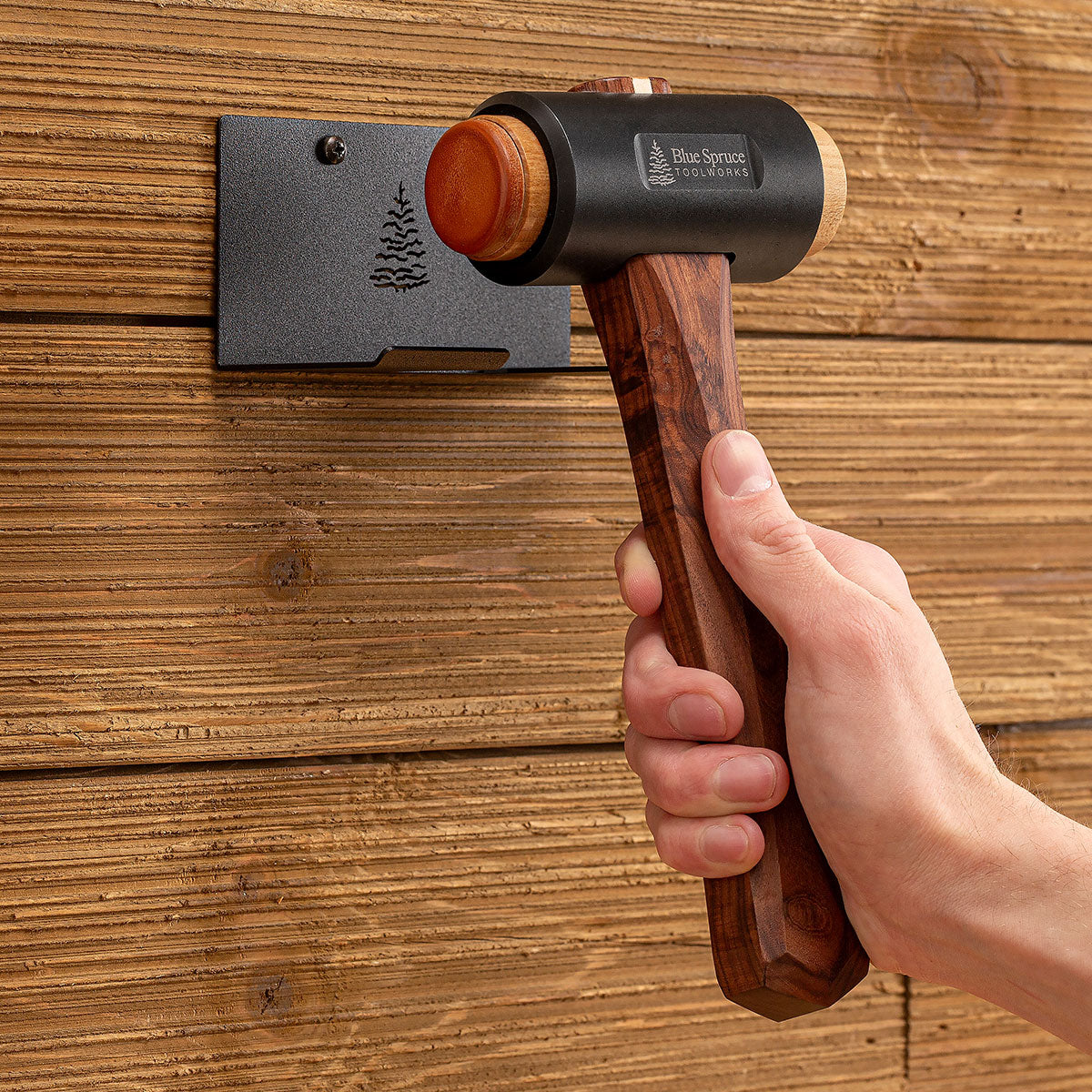
The Steel and Maple Woodworker’s Infill Mallet is Blue Spruce Toolworks’ modern interpretation of an infill-style mallet. Instead of being a simple wooden block on a handle, this mallet uses a compact steel head to concentrate mass, with wood and leather elements added to soften and control the strike.
According to Blue Spruce, the mallet uses a drawn-over-mandrel steel tube with a low-gloss black nitride finish. The infill is resin-infused maple, with harness leather bonded to one end for more delicate tapping. The handle is Bolivian rosewood with a faceted profile designed to feel secure in the hand.
The head measures roughly 1-1/2 inches by 4-3/4 inches, and the assembled head comes in at around 22 ounces, which is the interesting part. This is a compact tool, but it has real mass behind it. Blue Spruce positions it as useful for chopping mortises, assembling intricate joints, and other work where you want power without swinging a giant club around the bench.
As of May 29, 2026, the listed price is $129.99, with the product page showing an estimated 8-week ship time.
Why It Caught My Attention
There are a lot of woodworking tools that are merely functional. There are also plenty that are beautiful but not especially useful. This mallet appears to live in the more interesting middle ground: a genuinely functional shop tool that also feels like a design object.
The main thing that stands out is the balance of materials. Steel gives it mass. Resin-infused maple gives it a durable striking surface. Leather gives it a gentler face for taps and assembly. Rosewood gives the handle warmth and visual contrast. That is a much more thoughtful recipe than “chunk of wood plus stick.”
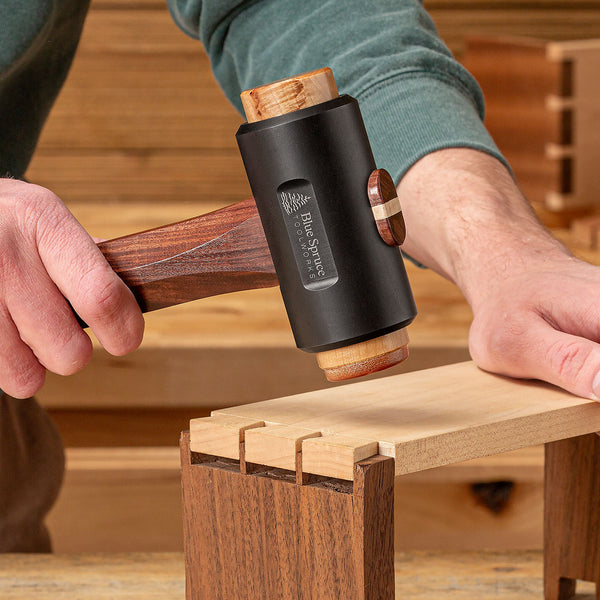
The design is also clearly aimed at controlled joinery work rather than brute-force demolition. A 22-ounce head in a compact body is a compelling idea. You get authority without needing an oversized mallet that gets clumsy around dovetails, mortises, small parts, or furniture assemblies.
And frankly, it looks fantastic. Some tools disappear into the shop. This one looks like it wants a little designated parking spot on the bench.
The Company Behind It: Blue Spruce Toolworks
Blue Spruce Toolworks has long had a strong reputation among hand-tool woodworkers for making precision tools that combine function with serious visual appeal. The company began as a part-time project by Dave Jeske, who designed a simple marking knife for smaller-scale precision joinery. Over time, the company expanded into bench chisels, dovetail chisels, paring chisels, butt chisels, frame saws, and mallets.
That origin story is important because it explains the feel of the brand. Blue Spruce tools have never really looked like generic catalog tools. They look like they were designed by someone who cares about the experience of using them, not just the mechanical function.
The company’s own mission language emphasizes tools that work flawlessly while also adding aesthetic beauty to the shop. That sounds lofty, but it also tracks with the product line. Their tools tend to have a “yes, this was designed on purpose” quality that a lot of production tools lack.
There is also a notable modern chapter in the company’s story. Blue Spruce’s manufacturing and distribution moved to Strongsville, Ohio, with expanded capacity to meet demand. The brand is now closely tied to Woodpeckers, and Dave Jeske’s own site states that he sold Blue Spruce Toolworks to Woodpeckers after nearly fifteen years of building the company.
That is worth mentioning because accuracy matters. Blue Spruce began as a small, highly personal toolmaking company, but it is now operating with more manufacturing capacity behind it. For some buyers, that may be reassuring. For others, the romance of the original small-shop story may matter. Either way, the current product still clearly carries the Blue Spruce design language: refined, premium, and unapologetically tool-nerdy.
Why It Might Belong in Your Shop
A mallet like this makes sense if you do a lot of chisel work, joinery, carving, furniture assembly, or small-scale precision woodworking. It is probably not the mallet you grab to knock apart a pallet or persuade a stubborn 2x4 into submission. This is more of a controlled-strike tool.
Where I think it could shine:
- Chopping mortises where you want concentrated force without an enormous swing.
- Dovetail and small joinery work where a bulky mallet feels clumsy.
- Furniture assembly where the leather face could be useful for gentler persuasion.
- Bench work where control matters more than raw violence.
- A refined hand-tool setup where the tool itself is part of the pleasure of working.
The best shop tools are not always the ones that do the most jobs. Sometimes they are the ones that make a specific task feel better, more precise, and more intentional.
This seems like that kind of tool.
What I’d Want to Know First
The biggest question is how it feels in the hand. At around 22 ounces in the head, it should have real authority, but the success of a mallet like this comes down to balance. Too head-heavy and it becomes tiring. Too refined and you might baby it instead of using it.
I would also want to know how the maple and leather faces hold up after extended use. Blue Spruce’s resin-infused maple should be more durable than ordinary maple, and the leather face is a smart addition for gentler contact, but long-term wear is always worth watching on a premium striking tool.
The other practical consideration is availability. The product page currently lists an 8-week ship time, so this is not necessarily an impulse-buy tool that shows up tomorrow.
Who It’s For
This is for woodworkers who enjoy hand-tool work and care about the quality of the tools on their bench.
It is especially suited for:
- Furniture makers
- Hand-tool woodworkers
- Joinery-focused woodworkers
- Chisel users
- Tool collectors who actually use their tools
- Makers who appreciate premium materials and thoughtful design
It is probably not the right choice for someone just trying to get the cheapest functional mallet. There are plenty of perfectly usable wooden mallets you can buy or make for far less money.
But if you want a compact, beautiful, heirloom-feeling mallet that looks like it belongs next to premium chisels, this one makes a lot of sense.
Final Thought
The Blue Spruce Steel and Maple Woodworker’s Infill Mallet is not trying to be the most economical mallet in the shop. It is trying to be the one you enjoy picking up.
That matters more than some people admit. A good tool should perform well, but a great tool also changes the way you feel when you work. This mallet has that kind of presence. It is compact, dense, carefully detailed, and rooted in a woodworking tradition that values both precision and beauty.
For me, that makes it an easy fit for Tools I’m Tracking.
Not every tool needs to be a bargain-bin workhorse. Some tools earn attention because they make the bench feel more intentional. This looks like one of them.
Product photography courtesy of Blue Spruce Toolworks. Used with permission. This article is part of Artisans Essentials’ “Tools I’m Tracking” series and is based on publicly available product information, company background research, and personal editorial interest.